 |
|
 |
Get our FREE |
|
|
|
|
Get our FREE |
    |




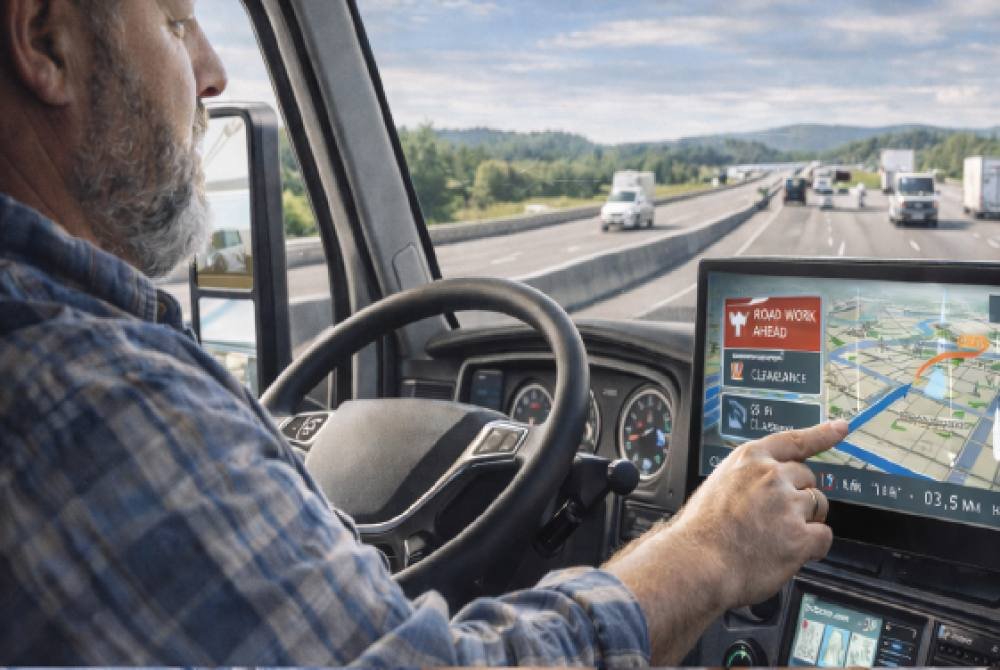
Not long ago, truck drivers relied on paper maps. Later came DVDs and digital memory cards that were updated periodically—and often arrived already outdated. Today, that reality is gone. At CES 2026, Remco Timmer, Senior Vice President of Automotive Solutions at HERE Technologies, explained how mapping has become one of the most critical technologies for mode
trucking operations.
According to Timmer, the industry has entered the era of the “AI-powered live map”—a cloud-connected system that is continuously updated. Unlike static maps, this model integrates data from vehicle sensors such as cameras, radar, lidar, and driver reports to detect real-world road changes, including construction zones, closures, height restrictions, or detours. That updated information is then distributed across fleets, often in less than 24 hours.
For freight transportation, this constant updating is essential. An undetected restriction can lead to blocked routes, delays, increased fuel consumption, or even safety risks. Information no longer flows in just one direction: drivers themselves can report hazardous conditions, creating a form of collective intelligence that benefits the entire fleet.
Another major shift is map unification. HERE has consolidated navigation, ADAS (Advanced Driver Assistance Systems), and assisted-driving functions into a single data source. This prevents inconsistencies between what the navigation system “sees” and what the driver-assistance system interprets—an increasingly critical factor as automation features continue to expand.
In fleet operations, the value of AI-driven mapping goes far beyond the individual truck. Routes are optimized at scale, taking into account vehicle weight, dimensions, hazardous materials, hours-of-service limits, traffic congestion, fuel consumption, and—especially for electric trucks—real-world range and charging availability. The goal is not just to arrive faster, but to lower costs and maximize uptime.
Even the so-called “last meter”—from the facility entrance to the correct loading dock—is optimized through precise, shared mapping data, helping drivers avoid wasted time at every delivery point.
The conclusion is clear: in mode
trucking, maps are no longer just navigation tools. They are critical digital infrastructure—an intelligent foundation that connects vehicles, fleets, and logistics in real time. In an industry where every minute matters, the future begins quietly, with the map.
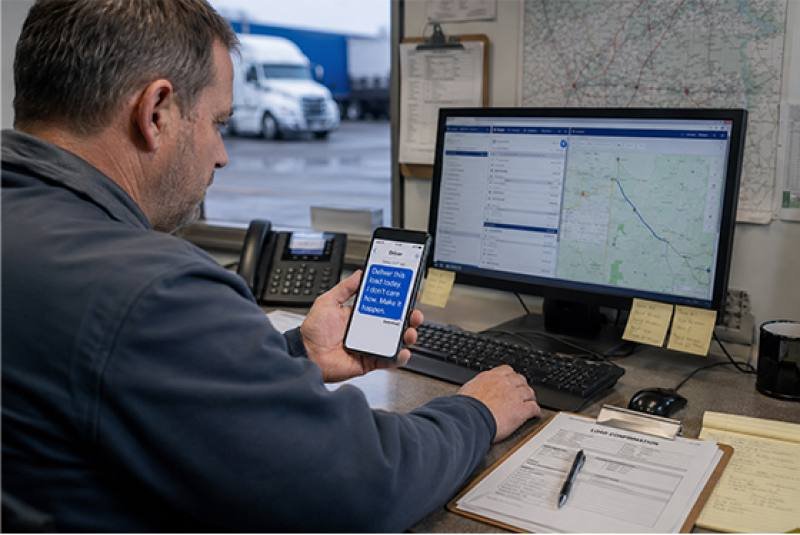
In trucking, tight delivery schedules can put drivers under a lot of pressure. The real problem starts when a dispatcher...
read more...
From August 23 through 29, 2026, Brake Safety Week will take place, with inspections focused on commercial vehicle braki...
read more...
Construction zones demand a driver’s full attention, especially when operating a loaded truck. Narrow lanes, sudde...
read more...
Ah, summer! It is one of the busiest times of the year for truckers, and with long hours on the road and plenty of fatig...
read more...